Research
Understanding buildings by understanding human behavior
Our research explores how people experience and interact with indoor environments. By combining immersive virtual environments with controlled changes in factors such as temperature, airflow, and lighting, we study how different conditions influence comfort, behavior, and decision-making. This approach allows us to test building strategies in realistic yet controlled scenarios, helping us better understand how buildings can respond to human needs.
Directions
The IHBI Lab explores how people interact with buildings and how these interactions shape energy use, comfort, and resilience.
01
RESEARCH DIRECTION 01
Occupant-centric Energy Transitions
This research direction focuses on how people experience and respond to energy-efficiency measures and changing energy systems in buildings. Participants interact with simulated environments where different strategies—such as temperature adjustments, ventilation changes, or dynamic energy pricing—can be explored in practice. Behavioral, perceptual, and physiological responses are monitored to understand how occupants adapt and make decisions.
By studying diverse social groups, including older adults and marginalized communities, this research supports the development of occupant-centric and inclusive solutions. The goal is to ensure that energy transitions are not only technically efficient, but also acceptable, equitable, and responsive to real human needs.
02
RESEARCH DIRECTION 02
Climate Resilience in the Built Environment
This research direction focuses on how people experience and respond to energy-efficiency measures and changing energy systems in buildings. Participants interact with simulated environments where different strategies—such as temperature adjustments, ventilation changes, or dynamic energy pricing—can be explored in practice. Behavioral, perceptual, and physiological responses are monitored to understand how occupants adapt and make decisions.
By studying diverse social groups, including older adults and marginalized communities, this research supports the development of occupant-centric and inclusive solutions. The goal is to ensure that energy transitions are not only technically efficient, but also acceptable, equitable, and responsive to real human needs.
Projects
Our projects apply these research directions in practice. Using immersive environments, climate simulations, and real-world studies, we explore how people interact with buildings and evaluate solutions for energy transitions and climate resilience.
[01]
Public Engagement in Urban Energy Transitions
This project makes complex urban energy and climate data accessible through an interactive visualization platform. As cities work to reduce carbon emissions and adapt to climate change, the platform helps residents understand building energy performance and climate resilience by transforming technical data into a clear and engaging public experience.
Building on research from the Intelligent Human-Buildings Interaction (IHBI) Lab at Umeå University and supported by InfraVis, users can explore how renovation strategies and behavioural choices affect energy use, carbon emissions, and resilience to climate extremes. The project aims to raise awareness, encourage sustainable renovation practices, and support more energy-efficient and climate-resilient cities.
Read more: Research[02]
Envisioning Sustainable Urban Transitions
This project explores how citizens can be more actively involved in sustainable and climate-resilient urban transitions. Although many policies and technical solutions exist, effective implementation is often limited by a lack of engagement, shared understanding, and practical tools. The project therefore investigates how communities can collaboratively discuss, envision, and shape sustainable futures.
Through applied research in Latvia, Sweden, and the Netherlands, the project develops creative and participatory methods to support municipalities and empower citizens in decision-making. Umeå University leads a work package focused on using interactive media, such as VR and AR, together with participatory design techniques to explore and co-create sustainable urban transitions.
Read more: Research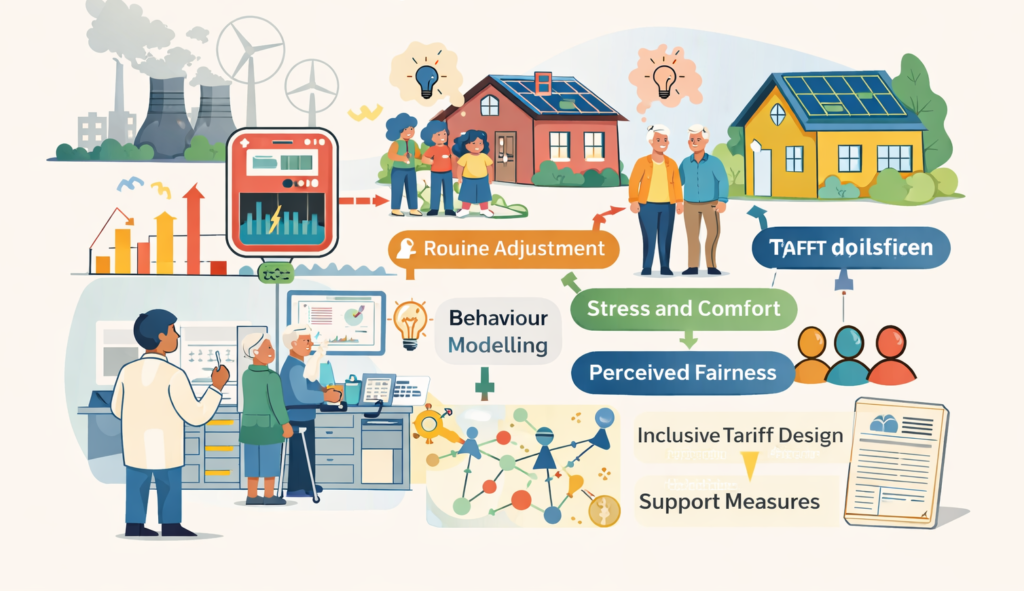
[03]
Equity in Sweden’s New Energy Tariff
This project examines the social impacts of Sweden’s upcoming effect-based electricity tariff, planned for nationwide implementation by 2027. While designed to reduce peak demand and support renewable energy integration, its consequences for different households—particularly low-income families and elderly residents—remain uncertain.
Using laboratory experiments, behavioural modelling, and agent-based simulations, the project explores how households perceive and respond to the tariff. The goal is to generate insights that support more inclusive tariff design and ensure a fair and socially sustainable energy transition.
Read more: ResearchInterested in our research?
We welcome collaborations across disciplines and industries!